Saturday, December 9, 2023

Covariance Risk Premium as a Predictor of Market Returns

Various prediction methods are employed in the stock market, leveraging diverse techniques and data sources. Fundamental analysis delves into a company's financial health, examining factors like earnings, assets, and management. Machine learning and artificial intelligence have gained prominence recently, using algorithms to analyze vast datasets and identify patterns elusive to traditional methods. Sentiment analysis gauges market sentiment by examining news articles, social media, and other sources to predict how emotions might influence stock prices. Econometric methods like ARIMA and GARCH add a statistical dimension, employing time-series analysis and volatility modeling to enhance predictions.

Reference [1] introduced a novel prediction method based on a concept called the covariance risk premium (CRP). CRP is defined as the expected physical and risk-neutral covariance of implied volatility changes and market index returns. The authors pointed out,

Through meticulous empirical analysis, we substantiate the predictive power of the CRP, revealing its compelling positive and significant impact on future stock market returns across time horizons spanning from one to 24 months. Our investigation covers the sample period of 1996 to 2019, demonstrating that the CRP’s predictive influence extends beyond the confines of in-sample assessments, thereby showcasing its robustness through out-of-sample tests. Importantly, the CRP’s predictive potential translates into substantial and noteworthy economic gains, offering a lucrative edge for mean-variance investors seeking to optimize their investment strategies. Notably, the resilience of our findings is underscored by their consistent validation across the alternative specification of the CRP.

Overall, this study underscores the pivotal role of the CRP as a potent predictor of stock market returns, fortified by both sound theoretical foundations and empirical validation. The empirical insights emanating from our research serve as a guiding compass for investors aiming to maximize returns.

In short, the paper showed that the CRP can predict well the stock market returns both in- and out-of-sample. Moreover, it performs better than many widely utilized predictors.

Let us know what you think in the comments below or in the discussion forum.

References

[1] Jia, Xiaolan and Ruan, Xinfeng and Zhang, Jin E., Covariance Risk Premium and Expected Stock Returns (October 19, 2020). https://ift.tt/7LRzYwg

Originally Published Here: Covariance Risk Premium as a Predictor of Market Returns


source https://harbourfronts.com/covariance-risk-premium-predictor-market-returns/

Stock Exchange: What It Is, Purpose, Function, Examples

In the bustling arena of finance, the stock exchange stands as a dynamic hub where fortunes are made, companies are valued, and economic landscapes are shaped. This blog post ventures into the heart of the financial world, unraveling the intricate tapestry of the stock exchange – a vital institution that plays a pivotal role in the global economy.

What is a Stock Exchange

At its core, a stock exchange is a marketplace where buyers and sellers convene to trade shares of publicly listed companies. This exchange provides the infrastructure and framework for the buying and selling of stocks, bonds, and other financial instruments. It serves as a conduit for capital to flow between investors and corporations.

Purpose and Function

The primary purpose of a stock exchange is to facilitate the efficient allocation of capital. By connecting companies in need of funding with investors seeking opportunities, the stock exchange allows for the buying and selling of ownership stakes in publicly traded companies. This mechanism not only provides liquidity to investors but also enables companies to raise capital for expansion, research, and other strategic initiatives.

Key Components of a Stock Exchange

  1. Listed Securities: Companies that choose to go public and offer their shares for trading on the exchange become listed securities. These can include stocks, bonds, and other financial instruments.
  2. Brokers and Traders: Individuals and institutions known as brokers and traders engage in buying and selling securities on behalf of investors. They facilitate the transactions on the exchange.
  3. Indices: Stock exchanges often have indices, such as the S&P 500 or FTSE 100, which measure the performance of a specific group of stocks and serve as indicators of market trends.

Examples of Stock Exchanges

  1. New York Stock Exchange (NYSE): Located on Wall Street, the NYSE is one of the world's largest and most iconic stock exchanges.
  2. NASDAQ: Known for its technology-focused listings, NASDAQ is a major U.S. stock exchange that operates electronically.
  3. London Stock Exchange (LSE): The LSE is one of the oldest stock exchanges globally, playing a key role in the international financial landscape.

The Impact on Investors

For investors, the stock exchange offers opportunities for wealth creation and portfolio diversification. It allows individuals to become partial owners of companies they believe in and share in their successes.

Conclusion

The stock exchange is not merely a marketplace; it is a dynamic force that influences economies, shapes industries, and empowers investors. Understanding its mechanisms is essential for anyone looking to navigate the complexities of the financial world. Whether you are an aspiring investor or a seasoned financial professional, the stock exchange remains a fascinating and integral component of the global economic system.

Originally Published Here: Stock Exchange: What It Is, Purpose, Function, Examples


source https://harbourfronts.com/stock-exchange/

Friday, December 8, 2023

Frictional Unemployment: Definition, Formula, Causes, Benefits

When it comes to economics, it's impossible to ignore the impact of unemployment. One particular type of unemployment, often overlooked yet significant, is frictional unemployment.

This idea sheds light on the job market, giving a new understanding of employment dynamics.

It's not about job absence or economic downturn - rather, it's a natural event within any healthy economy. Understanding how it works will help to capture the bigger picture of employment, and contribute to developing effective policies.

What is Frictional Unemployment?

In every thriving economy, there are situations where people quit their jobs to find new ones or fresh graduates actively searching for a job. This naturally creates a state of temporary unemployment, often known as frictional unemployment.

This type of unemployment is considered to be voluntary or transitional and is mostly caused by the time lag between leaving one job and finding another.

This indicates a healthy labor market with fluidity and demand. From an economic perspective, this shows that the economy is growing, and people are exploring better opportunities.

Causes of Frictional Unemployment

The primary cause of frictional unemployment is the transition period between jobs. Other factors that contribute to this type of unemployment include

  1. Change of Location: One of the most common and significant reasons for frictional unemployment is when a person moves to a new location, either voluntarily or due to job requirements. This relocation may lead to a period of searching and waiting for suitable job opportunities in the new area.
  2. Seasonal Jobs: Some industries are affected by seasonal fluctuations, leading to temporary layoffs during slow seasons. Workers in these industries may experience periods of unemployment while waiting for their jobs to resume.
  3. Mismatch of Skills and Job Requirements: It only makes sense that people are more likely to search for jobs that match their skills and qualifications. However, this may lead to a temporary period of unemployment as they wait for the right job opportunity.
  4. Delay in the Hiring Process: There can be many reasons for a delay in the hiring process, such as lengthy recruitment procedures or background checks. These delays may cause frictional unemployment for job seekers who have already left their previous jobs.

Impact of Frictional Unemployment

Frictional unemployment, although temporary, has a significant impact on the economy. It can affect individuals and the overall labor market in several ways.

  1. Individuals: Frictional unemployment can have a negative impact on individuals, causing financial strain and uncertainty. The period of job searching and waiting can be stressful and may lead to a decrease in quality of life.
  2. Employers: Employers also feel the effects of frictional unemployment as they search for qualified candidates to fill vacancies. This process can be time-consuming and costly, leading to a loss of productivity for businesses.
  3. Economy: A certain level of frictional unemployment is considered healthy for the economy as it reflects growth and job mobility. However, if it exceeds a certain point, it can lead to inefficiency in the labor market and slow down economic growth.

Advantages of Frictional Unemployment

Frictional unemployment may seem like a negative aspect of the labor market, but it also has its advantages.

  1. Job Availability: As people find new and better job opportunities, it opens up vacancies for others to fill. This creates a continuous cycle of job availability in the market.
  2. Better Job Matches: Frictional unemployment gives people the opportunity to find jobs that align with their skills, qualifications, and interests. This leads to a more productive workforce and can positively impact overall economic growth.
  3. Economic Growth: As mentioned earlier, a certain level of frictional unemployment is a sign of a healthy economy. It reflects job mobility and growth potential, which can lead to economic expansion.

Conclusion

Frictional unemployment may not receive as much attention as other types of unemployment, but it plays a crucial role in the dynamics of the job market. Understanding how it works can give a better understanding of the overall employment situation and contribute to creating effective policies for a thriving economy.

Post Source Here: Frictional Unemployment: Definition, Formula, Causes, Benefits


source https://harbourfronts.com/frictional-unemployment/

Thursday, December 7, 2023

Subsidiary Ledger: Definition, Meaning, Example, Reconciliation, Advantages

A general ledger is an accounting record summarizing financial transactions for a specific account. However, companies need more information than that provided in this ledger. Therefore, they may use a supplementary record to back it up, known as the subsidiary ledger.

What is a Subsidiary Ledger?

A subsidiary ledger is a supplementary and detailed accounting record that supports a corresponding general ledger account. Its primary function is to provide a more intricate breakdown of the balances in the general ledger, offering a comprehensive view of specific transactions or categories associated with a particular account. They commonly include accounts such as accounts payable, inventory, fixed assets, etc.

For instance, while the general ledger may feature an overarching account for "Accounts Receivable," the subsidiary ledger for accounts receivable would delve into individual customer accounts, delineating transactions, payments, and outstanding balances for a more nuanced financial overview. These subsidiary ledgers enhance the precision and organization of an accounting system by offering detailed insights into specific aspects of a company's financial transactions.

How does a Subsidiary Ledger work?

A subsidiary ledger operates as a supplementary layer within an organization's accounting structure, intricately connected to the general ledger. It is a detailed repository for specific transaction categories, like individual customer accounts or inventory items. Transactions are recorded, encompassing essential details such as dates and amounts.

Periodically, the subsidiary ledger undergoes summarization, and the cumulative totals are integrated into the corresponding general ledger accounts. This synchronized process ensures that the broader financial records accurately encapsulate the nuanced details embedded in the subsidiary ledger. By affording users direct access to detailed transaction information, the subsidiary ledger empowers a more refined analysis of financial data.

Why is the Subsidiary Ledger important?

Subsidiary ledgers offer a multifaceted set of advantages in accounting, starting with their ability to establish detailed recordkeeping. By recording individual transactions within specific categories, these ledgers provide organizations with a comprehensive and granular overview of their financial activities. This intrinsic detail enhances accuracy in financial reporting and streamlines the identification and rectification of errors.

Through efficient analysis, accountants and financial analysts can glean valuable insights, aiding in strategic decision-making and trend identification. The ability to customize reports based on subsidiary ledger data further empowers organizations, offering tailored perspectives on specific accounts or transaction categories and facilitating more nuanced financial planning.

What is the difference between a Subsidiary and a General Ledger?

The general ledger is the primary accounting record, offering a consolidated summary of all financial transactions across various accounts, such as assets, liabilities, equity, revenues, and expenses. It provides a high-level view of the organization's overall financial position and is crucial for external reporting and strategic decision-making. In contrast, a subsidiary ledger is a supplementary set of detailed records supporting specific accounts within the general ledger.

While the general ledger offers a consolidated and comprehensive overview of financial transactions, the subsidiary ledger functions as a detailed companion, breaking down information into specific categories or transactions within individual accounts. The general ledger is instrumental for external reporting and high-level decision-making, whereas subsidiary ledgers provide the necessary for internal management, enabling organizations to delve deeper into specific aspects of financial data.

Conclusion

A subsidiary ledger is an additional accounting record companies maintain that backs general ledgers. This type of ledger is common in areas such as accounts receivable, accounts payable, and inventory. Subsidiary ledgers allow companies to keep detailed financial information that the general ledger does not include.

Article Source Here: Subsidiary Ledger: Definition, Meaning, Example, Reconciliation, Advantages


source https://harbourfronts.com/subsidiary-ledger/

How Hedging Frequency and Volatility Affect Profit and Loss

Delta hedging is a risk management strategy widely used in financial markets, particularly in options trading. The primary objective of delta hedging is to offset or neutralize the directional risk, or delta exposure, associated with an options position.

Delta represents the sensitivity of an option's price to changes in the price of the underlying asset. To implement delta hedging, traders adjust their positions in the underlying asset (stocks, for example) to counterbalance the delta of the options they hold. If a trader is long an option with a delta of 0.6, indicating sensitivity to price changes, they might sell or short 60 shares of the underlying asset to create a delta-neutral portfolio. This dynamic strategy helps traders manage risk by mitigating potential losses due to changes in the underlying asset's price, creating a more stable and predictable portfolio.

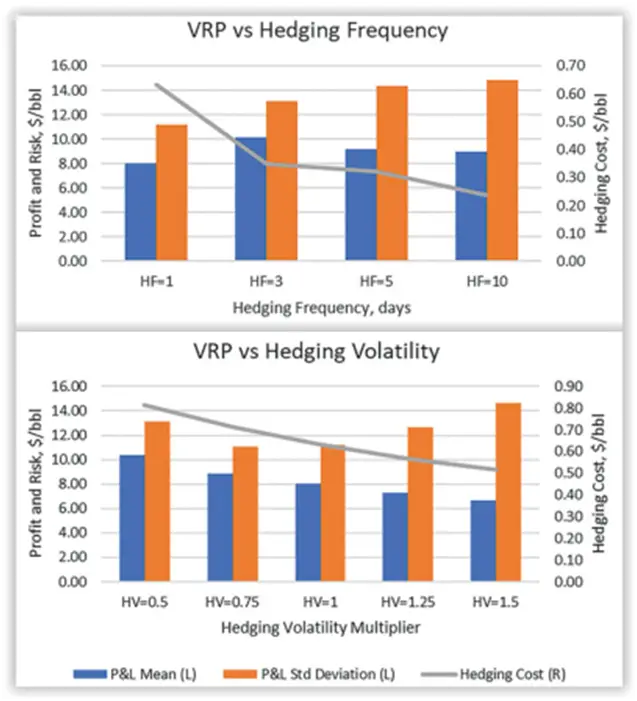
When delta hedging, a crucial question arises: how often should we hedge, and what volatility should be used to calculate the delta? Reference [1] investigates this question within the context of the oil market. The author pointed out,

It is not surprising that with less frequent hedging, the risks measured by the annualized standard deviation of the portfolio’s P&L steadily increase. More interesting is the observation that annualized profits also increase slightly if the portfolio does not rebalance the delta for at least two days. This confirms that some additional gains can indeed be captured from short-term price reversals by leaving the portfolio unhedged for a few days. If instead of hedging every day, the trader hedges only every two or three days, then higher profitability adequately compensates for taking larger risks while simultaneously saving on transaction costs. However, leaving the strategy unhedged for more than a week makes it less attractive on a risk-adjusted basis. While such a strategy allows traders to benefit from short-term price reversals, it can suffer significant losses if the portfolio is left unhedged for too long.

The findings are consistent with our intuitions: hedging less frequently increases PnL variance but decreases costs. However, there's an interesting finding: hedging more frequently doesn't yield the highest expected return. In other words, there exists an optimal hedging frequency that maximizes the expected return.

The author also explores different hedging volatilities,

To illustrate VRP sensitivity to the choice of the hedging delta, we scale the hedging volatility by multiples of 0.5, 0.75, 1.25, and 1.5 of the prevalent implied volatility. The multiple of 1.0 represents the base case. The results of this experiment are summarized in Fig. 9.10.

The most interesting takeaway from this analysis is P&L improvement from hedging with low volatility and P&L decline for hedging with high volatility.

In short, there's no need to hedge using implied volatility. Opting for lower volatility in hedging results in a higher expected return.

These findings are insightful. It's important to note, however, that they specifically pertain to short gamma positions. If you’re long gamma, the conclusions might vary.

Let us know what you think in the comments below or in the discussion forum.

References

[1] Bouchouev, I. (2023). The Art and Science of Delta Hedging. In: Virtual Barrels. Springer Texts in Business and Economics. Springer, Cham, pg. 202

Originally Published Here: How Hedging Frequency and Volatility Affect Profit and Loss


source https://harbourfronts.com/hedging-frequency-volatility-affect-profit-loss/

Monday, December 4, 2023

Different Types of Customers

Understanding the various types of customers is paramount in the contemporary business landscape as it enables companies to tailor their approaches and services, fostering stronger relationships and enhancing customer satisfaction. Each customer type comes with unique expectations, preferences, and behaviors that, when recognized and addressed, can guide businesses in optimizing their marketing strategies, communication methods, and product offerings. This nuanced understanding empowers companies to create personalized experiences, meet diverse needs, and ultimately build lasting customer loyalty.

In a competitive market where customer expectations continue to evolve, businesses that grasp the intricacies of their customer base can adapt more effectively, stay ahead of trends, and position themselves for sustained success. This blog post explores the fascinating array of customer types, shedding light on their characteristics and implications for businesses.

1. Loyal Customers

Loyal customers are the bedrock of business success. These individuals consistently choose a particular brand or company, often due to positive past experiences, brand affinity, or loyalty programs. Building and maintaining relationships with loyal customers is crucial for fostering brand advocacy and repeat business.

2. Impulse Buyers

Impulse buyers make purchasing decisions spontaneously, often driven by emotions, promotions, or the thrill of the moment. Understanding the psychology behind impulse buying can help businesses optimize their marketing strategies to capture these fleeting opportunities.

3. Bargain Hunters

Bargain hunters are always on the lookout for the best deals, discounts, and value for money. Price-sensitive, they are swayed by promotions and sales. Catering to this segment requires businesses to strategically price products, offer promotions, and communicate value propositions effectively.

4. Window Shoppers

Window shoppers browse without immediate intent to buy. While they may not convert into customers during every visit, providing a positive shopping experience and creating brand awareness can influence their future purchasing decisions.

5. Demanding Customers

Demanding customers have high expectations and specific requirements. They seek personalized experiences, prompt customer service, and top-notch product quality. Meeting the demands of this customer segment is a challenge but can lead to strong brand loyalty if executed effectively.

6. New Customers

New customers represent untapped potential for businesses. Capturing their attention through effective marketing, onboarding processes, and first impressions is crucial to converting them into repeat customers.

7. Tech-Savvy Customers

In the digital age, a significant segment of customers is tech-savvy. They prefer online shopping, utilize mobile apps, and engage with brands on social media. Businesses need to have a robust online presence and user-friendly technology to cater to this customer type.

Conclusion

In the kaleidoscope of customer diversity, recognizing the different types is not just an exercise in segmentation but a strategic necessity. Tailoring marketing approaches, customer service, and overall business strategies to accommodate the preferences and behaviors of these diverse customer types can lead to enhanced customer satisfaction, loyalty, and sustainable business growth. As businesses continue to evolve, understanding and adapting to the ever-changing landscape of customer diversity remains a dynamic and essential aspect of success.

Originally Published Here: Different Types of Customers


source https://harbourfronts.com/types-of-customers/

Asset Valuation: Definition, Formula, Approaches, Methods, Importance

The term 'Asset Valuation' might seem complex, but it's a fundamental concept in finance and investment. It's a process that involves determining the worth of assets, from stocks and bonds to real estate and machinery.

Understanding this method can unlock new standpoints on investment opportunities and financial management. It can be used in various scenarios, from buying a new house to evaluating the performance of a company's assets.

What is Asset Valuation?

Asset valuation is essentially a process to find out how much something is worth. For example, if there's a house, a piece of land, or a company, how does one determine its value?

This is where asset valuation comes in. It uses specific methods to calculate the value.

This value can help in various situations, such as selling the asset, buying it, or even for tax purposes. It can be used for almost anything that has a tangible value and can be bought, sold, or used to generate income.

Some other examples would be stocks, bonds, machinery, intellectual property, etc...

How Assets Valuation Works

In simple words, asset valuation is the process of determining the fair market value of an asset. It involves studying the asset's physical condition, its earning capacity, the market trends, and comparing it with similar assets.

Different methodologies are used depending on the nature of the asset. The goal of asset valuation is to provide a basis for decision-making in buying, selling, or managing the asset.

It helps buyers assess whether the asking price for an asset is reasonable and makes sellers aware of the value of their assets.

It also helps companies understand the performance of their assets and make informed decisions regarding investment and divestment.

Methods of Asset Valuation

There are various methods used in asset valuation, each with its own set of advantages and limitations - some common methods include

  1. Cost Method: This method calculates an asset's value based on the cost to replace it with a similar one at current prices, considering depreciation. It's commonly used for physical assets like buildings or machinery.
  2. Market Method: This compares the assets with similar ones recently sold in the market. It's often used for valuing real estate and businesses.
  3. Income Method: This calculates an asset's value based on the income it can generate in the future. It's typically used for investments like stocks or bonds.
  4. Value-based Method: This method considers the asset's potential value to the owner, not just its market value. It might consider factors like strategic importance or synergies in a merger.

Importance of Asset Valuation

Here are some of the key reasons why asset valuation is so important

  1. Informed Decision Making: Asset valuation provides a solid basis for making decisions about buying, selling, or holding an asset.
  2. Financial Reporting: Companies need to report the value of their assets accurately in their financial statements. This helps investors, creditors, and other stakeholders understand the company's financial health.
  3. Taxation: The value of an asset is often used to calculate taxes. Accurate valuation ensures that the correct amount of tax is paid.
  4. Insurance: When it comes to insuring an asset, knowing its actual value is crucial. It helps in determining the right amount of coverage and premiums.
  5. Investment Opportunities: Understanding the value of assets can help investors identify attractive investment opportunities and make informed decisions about portfolio management.

Conclusion

In conclusion, asset valuation is a crucial concept in finance that involves determining the worth of assets using specific methods. It plays a crucial role in decision-making and should be done accurately. By understanding how asset valuation works and its various methods, businesses can make more informed financial decisions and capitalize on investment opportunities.

Post Source Here: Asset Valuation: Definition, Formula, Approaches, Methods, Importance


source https://harbourfronts.com/asset-valuation/

Sunday, December 3, 2023

Consolidated Financial Statements: Definition, Example, Meaning, Importance, vs Unconsolidated Financial Statements

When a company acquires interest in another company, it must establish a relationship. If this relationship is deemed “controlling”, the parent company must prepare consolidated financial statements.

What are Consolidated Financial Statements?

Consolidated financial statements are a crucial tool in financial reporting that combines the financial information of a parent company and its subsidiary entities into a single, unified set of reports. This practice is particularly relevant when a parent company holds a controlling interest (typically more than 50% of the voting rights) in one or more subsidiary companies.

Consolidated financial statements include primary components like the income statement, balance sheet, and cash flow statement, offering a comprehensive view of the financial performance and position of the entire group as if it were a single economic entity. These statements play a vital role in legal compliance, allowing companies to meet regulatory requirements in many jurisdictions and provide an accurate representation of the group's financial health.

How do Consolidated Financial Statements work?

Consolidated financial statements integrate the financial data of a parent company and its subsidiary entities into a unified set of reports. The process commences by collecting individual financial statements from each entity, including income statements, balance sheets, and cash flow statements, adhering to standard accounting principles.

Consolidated financial statements remove intercompany transactions to ensure accuracy and prevent duplication. Following this, the financial information from the parent and its subsidiaries gets aggregated and combined, encompassing revenues, expenses, assets, liabilities, and equity. In cases where the parent company does not hold 100% ownership of a subsidiary, the portion of equity attributable to non-controlling interests is separately disclosed.

The consolidated financial statements include an income statement, presenting consolidated revenue, expenses, gains, and losses, a balance sheet that reveals consolidated assets, liabilities, and equity and a cash flow statement detailing the group's cash flows from operating, investing, and financing activities. These statements offer a comprehensive overview of the group's financial performance and position, creating a unified representation as a single economic entity.

What is the importance of Consolidated Financial Statements?

Consolidated financial statements are of paramount importance in the world of finance and accounting. They offer a comprehensive and accurate view of the financial performance and position of companies under common control. By combining the financial information of a parent company and its subsidiaries into a single set of reports, consolidated statements eliminate intercompany transactions and provide a unified representation of the group's financial health.

This level of accuracy and transparency is crucial for investors and creditors when assessing the overall financial stability and prospects of the group. It instills confidence and aids in making informed investment and lending decisions and evaluating the group's creditworthiness. For internal management, consolidated financial statements are vital for strategic decision-making and resource allocation.

What's the difference between Consolidated and Unconsolidated Financial Statement?

The primary distinction between consolidated and unconsolidated financial statements lies in what they portray and how they are prepared. Consolidated financial statements present the combined financial performance and position of a group of companies under common control as a single economic entity. These statements integrate the financial data of the parent company and its subsidiaries to provide a unified view.

In contrast, unconsolidated financial statements, also known as separate financial statements, depict the financial status of individual entities in isolation. They do not incorporate financial information from subsidiary companies, reflecting the standalone financial condition of each entity. Overall, unconsolidated financial statements are geared toward analyzing the financial status of individual entities within the group.

Conclusion

Consolidated financial statements reflect the combined results of a parent and subsidiary company. They follow a format provided by accounting standards. Under most jurisdictions, parent companies must prepare consolidated financial statements when a controlling interest with a subsidiary exists. These statements differ from the individual company’s financial statements.

Post Source Here: Consolidated Financial Statements: Definition, Example, Meaning, Importance, vs Unconsolidated Financial Statements


source https://harbourfronts.com/consolidated-financial-statements/

Using a Parametric Implied Volatility Surface for Calculating Value At Risk

Value at Risk (VaR) is a widely used risk metric in finance, providing an estimate of the potential loss on a portfolio or investment over a specific time horizon, under normal market conditions. It quantifies the level of financial risk within a certain confidence interval, expressing the maximum loss that might be incurred over a given period.

Calculating VaR for linear instruments is straightforward, but for instruments with convexities, such as options, the process becomes more complex. Reference [1] has proposed a method for calculating the daily VaR of an options portfolio. The authors stated,

In our proposed method, we initiate the process by extracting the volatility surface for each day from option prices. Subsequently, volatility shocks are computed based on historical data on the volatility surface, resulting in a database of projected volatility surfaces. Simultaneously, employing Monte Carlo simulation, we generate next-day prices for the underlying asset. These volatility shocks and next-day prices are then input into the Black-Scholes formula pricing model to obtain forecasts for option prices the following day.

Numerical tests reveal the superior performance of the PSP method, particularly at high confidence levels (e.g., 95%). The DM test emphasizes the effectiveness of localized volatility models over reference volatility, capturing market conditions more accurately. Furthermore, incorporating volatility, regardless of its form (reference or localized), demonstrates potential improvements in forecasting accuracy.

The method essentially begins by calculating daily stock moves using historical data. Subsequently, it determines the distribution of implied volatility associated with each simulated stock price through a method known as Parametric Surface Projection. This generated set of implied volatilities is then utilized to calculate the daily VaR of an options portfolio.

We find this method interesting and think it’s a good complement to analytical methods such as the delta-gamma-vega approach.

Let us know what you think in the comments below or in the discussion forum.

References

[1] Shiva Zamani, Alireza Moslemi Haghighi, Hamid Arian, Temporal Volatility Surface Projection: Parametric Surface Projection Method for Derivatives Portfolio Risk Management, https://ift.tt/C6RMjvS

Post Source Here: Using a Parametric Implied Volatility Surface for Calculating Value At Risk


source https://harbourfronts.com/using-parametric-implied-volatility-surface-calculating-value-risk/

Friday, December 1, 2023

Debtor vs Creditor: What’s the Difference?

In the intricate world of finance, terms like debtor and creditor are fundamental but often misunderstood. Understanding the distinction between these two entities is crucial for anyone navigating financial transactions, whether in personal finance or business dealings. This blog post aims to unravel the nuances, responsibilities, and dynamics that set debtors and creditors apart.

Definitions of Debtor and Creditor

Debtor

A debtor is an individual, business, or entity that owes money or has an outstanding obligation to another party. This obligation arises from borrowing funds or obtaining goods or services on credit. Debtors can take various forms, from an individual with a credit card balance to a corporation with outstanding loans.

Creditor

On the flip side, a creditor is an entity or individual that extends credit or loans money to another party. Creditors can be banks offering loans, suppliers providing goods on credit terms, or individuals lending money. They are owed a sum of money by the debtor, creating a debtor-creditor relationship.

Key Differences

  1. Position in the Transaction:

- Debtor: Occupies the position of the party owing money.

- Creditor: Holds the position of the party to whom money is owed.

  1. Nature of the Relationship:

- Debtor: Has an obligation to repay a debt.

- Creditor: Expects repayment of the amount lent or credit extended.

Examples

- Debtor: A person with an outstanding credit card balance.

- Creditor: A bank providing a mortgage loan.

Debtor-Creditor Relationship

The debtor-creditor relationship is inherent in countless financial transactions. It forms the basis of credit systems, loans, and financial agreements. Managing this relationship responsibly is essential for maintaining healthy financial dynamics. Clear communication, adherence to payment terms, and a thorough understanding of financial obligations contribute to a harmonious debtor-creditor relationship.

Conclusion

In the intricate tapestry of financial interactions, the distinction between debtor and creditor serves as a cornerstone. Whether in personal finance or complex business transactions, recognizing the roles and responsibilities of debtors and creditors is essential for making informed financial decisions. As individuals and businesses engage in financial dealings, a nuanced understanding of this dynamic relationship empowers them to navigate the financial landscape with confidence and prudence.

Post Source Here: Debtor vs Creditor: What’s the Difference?


source https://harbourfronts.com/debtor-vs-creditor/